Travels of Kyle and Susan Cordes, including somewhat regular medical trips to Eldoret, Kenya.
Saturday, February 20, 2016
Saturday morning traffic jam
We are just leaving IU House for a weekend getaway at Island Camp on Lake Baringo and we've already run into traffic.
Friday, February 19, 2016
Air conditioning
Both Windows in this operating room have one pane that opens. Both are propped open with cardboard to keep them open as wide as possible. That's the closest thing you'll find to air conditioning in the operating rooms. And no screens...
Friday surgeries
The team is starting the last two surgeries for the day, Friday, at 4:00pm. Both are thyroidectomies.
They are operating in two adjacent rooms. Each surgery team is a mix of Americans and Kenyans. The surgeons in one room are Henry (Kenyan), Kia, and Susan. The other room has Kenyans Ruth and Makaya with Bruce and Aria, with some tag-teaming going on. They aren't all in there at once.
Following is a list of surgeries by day this year:
Day 1
Nasal mass removal (2)
Nasal polyps
Parotidectomy (2)
Endoscopic sinus surgery
Day 2
Parotidectomy (2)
Endoscopic sinus surgery
Thyroidectomy (2)
Thyroglossal duct cyst removal
Excision of giant hemi-facial neurofibroma
Day 3
Thyroidectomy
Palate mass removal
Direct laryngoscopy
Endoscopic sinus surgery (2)
Parotidectomy
Day 4
Thyroglossal duct cyst removal
Cystic hygroma removal
Neck lipoma removal
Direct laryngoscopy
Parotidectomy (2)
Thyroidectomy (2)
Day 5
Thyroidectomy (4)
Parotidectomy
Branchial cleft cyst removal
Neck mass removal (2)
Day 6
Endoscopic sinus surgery (3)
Thyroidectomy
Parotidectomy (2)
Facial mass removal
They are operating in two adjacent rooms. Each surgery team is a mix of Americans and Kenyans. The surgeons in one room are Henry (Kenyan), Kia, and Susan. The other room has Kenyans Ruth and Makaya with Bruce and Aria, with some tag-teaming going on. They aren't all in there at once.
Following is a list of surgeries by day this year:
Day 1
Nasal mass removal (2)
Nasal polyps
Parotidectomy (2)
Endoscopic sinus surgery
Day 2
Parotidectomy (2)
Endoscopic sinus surgery
Thyroidectomy (2)
Thyroglossal duct cyst removal
Excision of giant hemi-facial neurofibroma
Day 3
Thyroidectomy
Palate mass removal
Direct laryngoscopy
Endoscopic sinus surgery (2)
Parotidectomy
Day 4
Thyroglossal duct cyst removal
Cystic hygroma removal
Neck lipoma removal
Direct laryngoscopy
Parotidectomy (2)
Thyroidectomy (2)
Day 5
Thyroidectomy (4)
Parotidectomy
Branchial cleft cyst removal
Neck mass removal (2)
Day 6
Endoscopic sinus surgery (3)
Thyroidectomy
Parotidectomy (2)
Facial mass removal
How to build a culvert
I pass by this work site walking from IU House to the hospital or town. This is where they are building one of those wide pedestrian paths.
The first day I passed by, I noticed what was going on. They were building a culvert where the walkway will cross a ditch right after the walkway crosses a road. They placed this long, inflatable tube in the ditch. I'm not sure if it was full of air, water, or what. Then they built forms around the tube at each side of the walkway.
The next day, they were mixing concrete on site and pouring it on and around the tube.
And the next day, the tube had been deflated and removed. The last picture shows a couple of deflated tubes laying near the worksite.
The first day I passed by, I noticed what was going on. They were building a culvert where the walkway will cross a ditch right after the walkway crosses a road. They placed this long, inflatable tube in the ditch. I'm not sure if it was full of air, water, or what. Then they built forms around the tube at each side of the walkway.
The next day, they were mixing concrete on site and pouring it on and around the tube.
And the next day, the tube had been deflated and removed. The last picture shows a couple of deflated tubes laying near the worksite.
Thursday, February 18, 2016
Breakfast at IU House
Breakfast at IU House is basic but sufficient. It consists of cereals (corn flakes and Wheatabix) and milk, bananas, toast with various spreads, coffee and tea. Eggs are available if you want to cook them yourself in the industrial kitchen.
Everyone seems to settle into their breakfast routine and have the same thing day after day. And year after year for repeat visitors.
Many aren't fans of the milk and avoid the cereal option. The milk is whole milk, ultra-pasteurized (expiration date 6 months), in these plastic bag things that hold 500ml each (about 2 cups). The milk is warm and not very white. I don't mind it but would prefer some nice, cold 1%.
The Campbells each have an Elvis breakfast of toast with peanut butter and banana slices. The local peanut butter is...ok, but it's kind of gritty, kind of oily. So this year, the third year for the Campbells, they brought their own Jiff. Because, you know, choosy mothers choose Jiff. And I don't blame them one bit. Next year, maybe I'll bring some Smucker's jelly, to avoid the weird plum stuff they serve here.
Everyone seems to settle into their breakfast routine and have the same thing day after day. And year after year for repeat visitors.
Many aren't fans of the milk and avoid the cereal option. The milk is whole milk, ultra-pasteurized (expiration date 6 months), in these plastic bag things that hold 500ml each (about 2 cups). The milk is warm and not very white. I don't mind it but would prefer some nice, cold 1%.
The Campbells each have an Elvis breakfast of toast with peanut butter and banana slices. The local peanut butter is...ok, but it's kind of gritty, kind of oily. So this year, the third year for the Campbells, they brought their own Jiff. Because, you know, choosy mothers choose Jiff. And I don't blame them one bit. Next year, maybe I'll bring some Smucker's jelly, to avoid the weird plum stuff they serve here.
Wednesday, February 17, 2016
Aria's project, continued
Aria spent Wednesday afternoon in clinic examining and asking questions of the previous thyroidectomy patients. In the photos, Aria uses a flexible endoscope, going in through the nose, down behind the tongue, to examine the vocal cords to make sure they still work properly after the surgery. Also pictured, David is helping him record the results they are collecting.
The flexible endoscope going in through the nose is uncomfortable, as you can imagine. But it's not THAT bad (so they tell me.) Before that part of the exam, he requests permission to do it. Well, Aria's first patient consented, and then hated it. Afterwards, as she left through the waiting area, she warned all the other patients about, telling them it was horrible. After that, Aria had a heck of a time talking patients into that part of the exam.
Language nuances
In the US, the term "scheme"has a negative connotation, almost to the point where it sounds unethical if not illegal. But in Kenya, it simply means "plan." We aren't talking about some diabolical scheme, rather just a way to invest funds. I see signs throughout town advertising pension "schemes".
Construction
I mentioned before that Eldoret is growing. Here's a 28 story office building being built. This building is twice as tall as the previous tallest building in Eldoret. Construction of this building is financed by the Moi University Pension Scheme. More on "schemes" later...
Wednesday night
The surgeons worked late Wednesday evening. They finished too late for dinner at IU House. Rather than go out for dinner, we decided to order pizzas for delivery. I knew this was a risk for today's schedule so I had purchased some South African red wines today. Our group had a nice pizza and wine dinner in the IU House cafeteria, chatting and laughing about a variety of topics. I didn't think to take a picture at the time. Now as I'm writing this, everyone has gone to bed except Susan, Aria, and me. Susan and Aria are taking about his research project. I'm writing this blog post...
Who's who and Aria's project
Dr. Aria Jafari, pictured
We have a great team on this trip, including
ENT'S
Susan Cordes
Bruce Campbell
Kia Jones
ENT Resident
Aria Jafari
Nurses
Vickie Firkins
Kathi Campbell
Diana Sullivan
Medical student
David Campbell
Flunky and blogger
Kyle Cordes
All are veteran participants with the exception of first year participant David Campbell, a fourth year medical student.
Aria is a resident from the University of California at San Diego. He is working on a research project that he began last year. I will try to explain what he is doing, as I understand it, so my explanation will be a non-medical layperson version...
One of the most common surgeries performed by our team over the years has been thyroidectomy. Most are for patients with a goiter that is big enough to cause health symptoms, typically trouble breathing. (Many want their large goiter removed for cosmetic reasons, but they will need to claim symptoms in order to have the surgery.) Goiters are caused by a lack of iodine in the diet. (In the US we have iodized salt.) One interesting fact is that most goiter patients here are women although men also have the same iodine shortage in their diet.
In the US, if a patient has a thyroidectomy, the entire gland is removed. The patient will then take medicine for life to replace the missing thyroid hormones. In Kenya, a thyroidectomy patient doesn't have access to such medicines because of the costs. Therefore, when the team removes a thyroid here, instead of removing the entire gland, they will leave a small portion of it behind. The idea is that the remaining part of the gland will still produce the necessary thyroid hormones but not grow into another goiter.
Aria's project is to collect and publish data on the subject. Very little data is currently available. Is doing it this way truly effective in this part of the world, under these circumstances?
Aria, with help from the ENT clinic nurses, has tracked down and contacted forty-some of the fifty-some thyroidectomy patients from previous trips. He is having them come to the ENT clinic for a follow-up exam and is having them get a blood test to check their thyroid hormone levels. Susan has helped him get approvals for the study and funding for the blood tests. Also, each patient is being given 1,000 Kenyan shillings (about $10) to pay their travel expenses from their village to Eldoret.
We have a great team on this trip, including
ENT'S
Susan Cordes
Bruce Campbell
Kia Jones
ENT Resident
Aria Jafari
Nurses
Vickie Firkins
Kathi Campbell
Diana Sullivan
Medical student
David Campbell
Flunky and blogger
Kyle Cordes
All are veteran participants with the exception of first year participant David Campbell, a fourth year medical student.
Aria is a resident from the University of California at San Diego. He is working on a research project that he began last year. I will try to explain what he is doing, as I understand it, so my explanation will be a non-medical layperson version...
One of the most common surgeries performed by our team over the years has been thyroidectomy. Most are for patients with a goiter that is big enough to cause health symptoms, typically trouble breathing. (Many want their large goiter removed for cosmetic reasons, but they will need to claim symptoms in order to have the surgery.) Goiters are caused by a lack of iodine in the diet. (In the US we have iodized salt.) One interesting fact is that most goiter patients here are women although men also have the same iodine shortage in their diet.
In the US, if a patient has a thyroidectomy, the entire gland is removed. The patient will then take medicine for life to replace the missing thyroid hormones. In Kenya, a thyroidectomy patient doesn't have access to such medicines because of the costs. Therefore, when the team removes a thyroid here, instead of removing the entire gland, they will leave a small portion of it behind. The idea is that the remaining part of the gland will still produce the necessary thyroid hormones but not grow into another goiter.
Aria's project is to collect and publish data on the subject. Very little data is currently available. Is doing it this way truly effective in this part of the world, under these circumstances?
Aria, with help from the ENT clinic nurses, has tracked down and contacted forty-some of the fifty-some thyroidectomy patients from previous trips. He is having them come to the ENT clinic for a follow-up exam and is having them get a blood test to check their thyroid hormone levels. Susan has helped him get approvals for the study and funding for the blood tests. Also, each patient is being given 1,000 Kenyan shillings (about $10) to pay their travel expenses from their village to Eldoret.
Tuesday, February 16, 2016
More for my AT&T friends
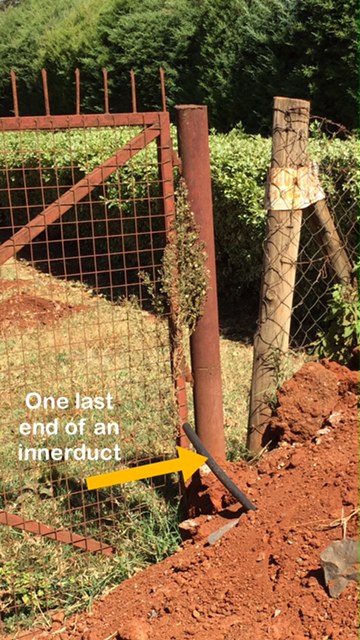
In 2010, I excitedly blogged about these new innerducts buried along the side of the road. I was sure that fiber optic cables would soon be pulled in or blown in. Subsequently I would report again every year or so that the innerducts were still there but no fiber cables.
Now this year, the nearby drainage ditch has been relocated and the grade has been raised, all for walkway work.
Only one end of one innerduct is still visible. Then, down the road a piece, innerducts are exposed at the bottom of the relocated drainage ditch. And a bit further away, one end of a cut innerduct is sticking out of the ditch floor.
I suppose it's possible that a fiber optic cable has been placed in one of the innerducts over the last year since I can no longer see all the ends at the fence post, but if it had, I would have expected to see a fiber splice there. But maybe they spliced a duct and pulled through. Wishful thinking on my part.
Now this year, the nearby drainage ditch has been relocated and the grade has been raised, all for walkway work.
Only one end of one innerduct is still visible. Then, down the road a piece, innerducts are exposed at the bottom of the relocated drainage ditch. And a bit further away, one end of a cut innerduct is sticking out of the ditch floor.
I suppose it's possible that a fiber optic cable has been placed in one of the innerducts over the last year since I can no longer see all the ends at the fence post, but if it had, I would have expected to see a fiber splice there. But maybe they spliced a duct and pulled through. Wishful thinking on my part.
Flush with money, infrastructure projects
Kenya and Eldoret have changed more over the last year than any previous annual visit. There are many public infrastructure improvement projects underway, and there are many new buildings under construction.
My Kenya friends tell me that the public works projects are a result of the new Kenyan constitution approved in 2010. One of the main provisions was to distribute tax revenues back to the counties instead of mostly staying in Nairobi. Do local governments have money for projects. We are seeing many new, wide walkways being cleared, leveled, and paved. If you're in congested traffic on a Kenyan road, you'd think there are too many cars. But Realty is that most Kenyans travel by foot. I'm used to not having sidewalks here. Mostly you have dirt paths along a road out try to walk on the edge of the road if there's room. These new walkways are a great improvement.
The upper photo shows a new path just finished. (The actual road is to the right.) The lower photo shows a more traditional walking path.
My Kenya friends tell me that the public works projects are a result of the new Kenyan constitution approved in 2010. One of the main provisions was to distribute tax revenues back to the counties instead of mostly staying in Nairobi. Do local governments have money for projects. We are seeing many new, wide walkways being cleared, leveled, and paved. If you're in congested traffic on a Kenyan road, you'd think there are too many cars. But Realty is that most Kenyans travel by foot. I'm used to not having sidewalks here. Mostly you have dirt paths along a road out try to walk on the edge of the road if there's room. These new walkways are a great improvement.
The upper photo shows a new path just finished. (The actual road is to the right.) The lower photo shows a more traditional walking path.
For my AT&T friends
In Kenya, if you're building something, and something is in your way, you simply build around, through, out over it. No rearrangements required. Here, the pole line is old and the fence is new.
Tuesday morning
The surgeons and nurses all left for the hospital early this morning for a full schedule of surgeries while I stayed back at IU House and restarted my annual Swahili lessons. Susan will be proud of me for starting at Lesson 4 instead of repeating Lesson 1 for the 8th year in a row.
Monday, February 15, 2016
Siam - Chinese restaurant
We had dinner Monday night at Siam, our favorite Chinese restaurant. Here are the Campbells, Kathi, David, and Bruce. I'll spell out who's who on a future post.
Monday afternoon clinic
Oh my there was a huge crowd of people waiting at the clinic. The docs saw countless patients and signed up enough surgeries for the entire trip.
Sunday, February 14, 2016
Amsterdam
We have caught up with Vickie and Diana in Amsterdam! Just one more 8 hour flight to complete our first 24 hours of travel.
Saturday, February 13, 2016
Inchworm, frogger, leap-frog
We have so much luggage. Mostly medical supplies. We are allowed 6 checked bags at 50 lbs each (packed to 52 lbs because we know they'll allow it) plus carry-ons. So we essentially have 8 pieces of luggage. That's two people trying to move 8 pieces of luggage. We're not superman. We can't each move 4 at a time.
So we and our luggage were dropped off at a shuttle drop-off island at the airport departure terminal. First step is to cross a few lanes of traffic to get into the terminal. Susan and I each took two bags across. She stayed with them while I made two more trips to move the other four. I was playing a human version of the old video game "Frogger", like George did in a Seinfeld episode, dodging cars, crossing the road with the luggage.
Then we inchworm our luggage to the check-in area, playing leap-frog as we go, traveling 20 feet or so at a time, never allowing a security person to think any have been abandoned.
It is such a relief to get checked in and not see that mess of luggage again until Nairobi!
So we and our luggage were dropped off at a shuttle drop-off island at the airport departure terminal. First step is to cross a few lanes of traffic to get into the terminal. Susan and I each took two bags across. She stayed with them while I made two more trips to move the other four. I was playing a human version of the old video game "Frogger", like George did in a Seinfeld episode, dodging cars, crossing the road with the luggage.
Then we inchworm our luggage to the check-in area, playing leap-frog as we go, traveling 20 feet or so at a time, never allowing a security person to think any have been abandoned.
It is such a relief to get checked in and not see that mess of luggage again until Nairobi!
Friday, February 12, 2016
Into San Francisco
Crossing the Golden Gate Bridge from "north bay" into the city. We are spending the night near the airport, awaiting our morning departure.
Most difficult part of the trip is the first step
Dropping off the dogs is the most difficult part of the trip. The dogs don't seem to mind, but it's hard on us. Here, they are being led into their temporary home by their caretaker.
Subscribe to:
Posts (Atom)